

From Slop to Pop: Simple techniques for writing with AI without losing your voice
Stop me if you have seen this before. You ask an AI to draft something, maybe a product update or a summary of a review or a blog post, and what comes back feels reasonably usable at first glance. It is organized and covers the points you gave it. Then you read it again and something feels off. It feels much like everything else you are reading these days - bold, terse statements with a tone of finality. Many, many single sentence paragraphs. I know it because I have indeed written a post or two myself in the early days of AI with such language. It's tempting to create something fast only to realize it's really bad slop. The tricky part isn't that the writing is bad. It feels somewhat competent and a little provocative, and that mix is what makes it hard to fix.
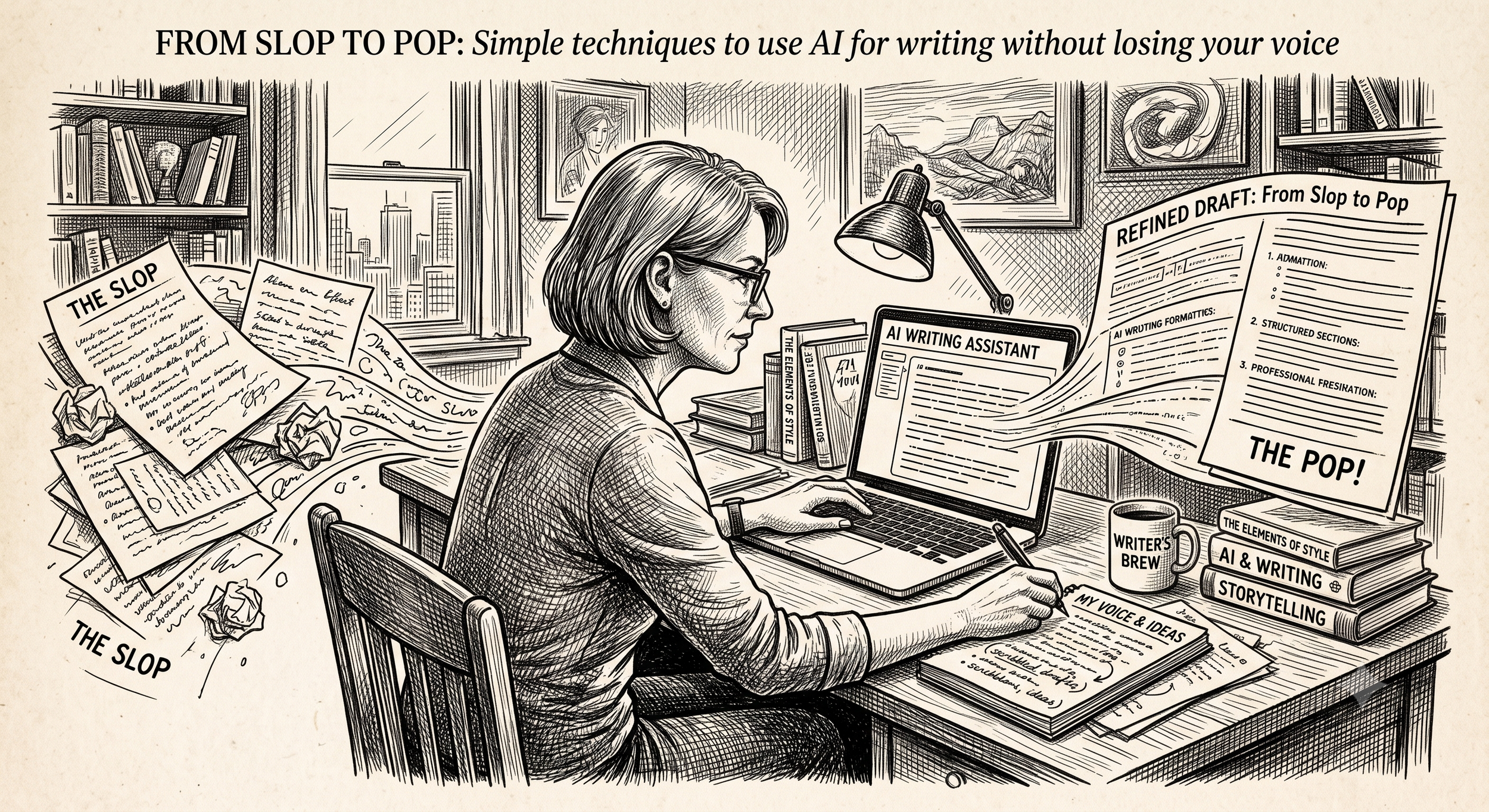
Barring some generational talent, I don't think our writing voice is anything mystical. It's mostly an accumulation of small choices over the years - the common words you reach for, the things you decide to mention or leave out, the way you'd explain an idea to someone sitting across from you, how and when you choose to use personal anecdotes, how often you lean on data versus experience. When a draft reads like an AI default, almost none of that comes through. The content may be entirely correct. What's missing is you and why you chose to put it this way.
But you can change it in a few simple ways. I asked my AI agent to pull together a list of things that I have asked for corrections in style over the past many months (yes I see the irony here). These are ways I have used AI for writing but still retained my own voice.
1. Lead with the point. Models like to warm up, opening with a sentence or two of scene-setting before they say anything real. You can cut it and start with a personal hook or what you think will get the reader engaged right away. Let your style come through, from the get-go.
2. Cut the words that aren't doing any work. This is less about brevity and more about noticing padding. Models love to fill space. A decent test is to remove a phrase and see whether the sentence lost any meaning. Keep it tight, give strict word counts and trim it down until what is left is the message and what makes it uniquely yours.
3. Focus on specifics, and notice what the adjectives are hiding. Adjectives let you claim a quality without pinning down facts. "A comprehensive review" commits to nothing, while "a review that went through the top ten customer complaints" commits to something real. Specifics make a post grounded and verifiable.
4. Watch for the tells. There's a familiar cluster of habits that reads as machine-written. Em-dashes in every paragraph, the "not this, but that" construction, lists of three arranged for rhythm, a closing line that lands like a slogan. Any one of them on its own is fine. What gives the slop away is the density, several packed into a small space. Thin them back toward how you actually write.
5. Read out loud before you send it. Reading aloud is the quickest way to catch where a draft stopped sounding like you and slid into slop, since you'll hear yourself say something you would never write. The AI default states everything at the same even level of confidence, while real thinking has gradations. We are sure of some things, and still evolving on others. Letting that show is a good part of what makes a piece feel like it came from a person.
A couple of other changes further upstream, in how you prompt, can also help a lot.
6. Give the model your style rules up front. A lot of the editing above can be front-loaded. Rather than fixing the same things on every draft, put your preferences into the prompt itself, or into the custom instructions the tool remembers between sessions, so it starts closer to where you want it. I keep a short style guide on hand for this, most of it distilled from William Zinsser's On Writing Well: lead with the point, cut the clutter, keep the verbs strong, go easy on adjectives. Pasting a handful of rules like that into the prompt shifts the first draft more than any single edit does later on. You'll save a ton of time and it adds up.
7. Tell it what not to do, show it how you write, and keep giving feedback. The model can't infer your voice from nothing, so left alone it drifts toward the average of everything it has read. Three habits I have found useful in this regard.
- Name the tics you want to avoid, something like "no em-dashes, don't open with scene-setting, keep the sentence lengths varied, no bold statements", which heads them off before they appear.
- Show your samples. Pasting in a paragraph you've written or better still old docs/posts that you think reflect your voice and style gives the model something concrete to imitate, which works far better than asking for "conversational" or "professional," words that carry almost no information for a chatbot.
- Keep talking. Give feedback, give samples, and constantly have a conversation. AI systems are really good at learning based on your feedback. Use that to your advantage. The more you teach, the more it learns to sound like you.
Beyond all this, focus on producing something you are proud of. If all it takes is a prompt with no personalization, anyone can do it. Why bother?