

Version One is just the start.
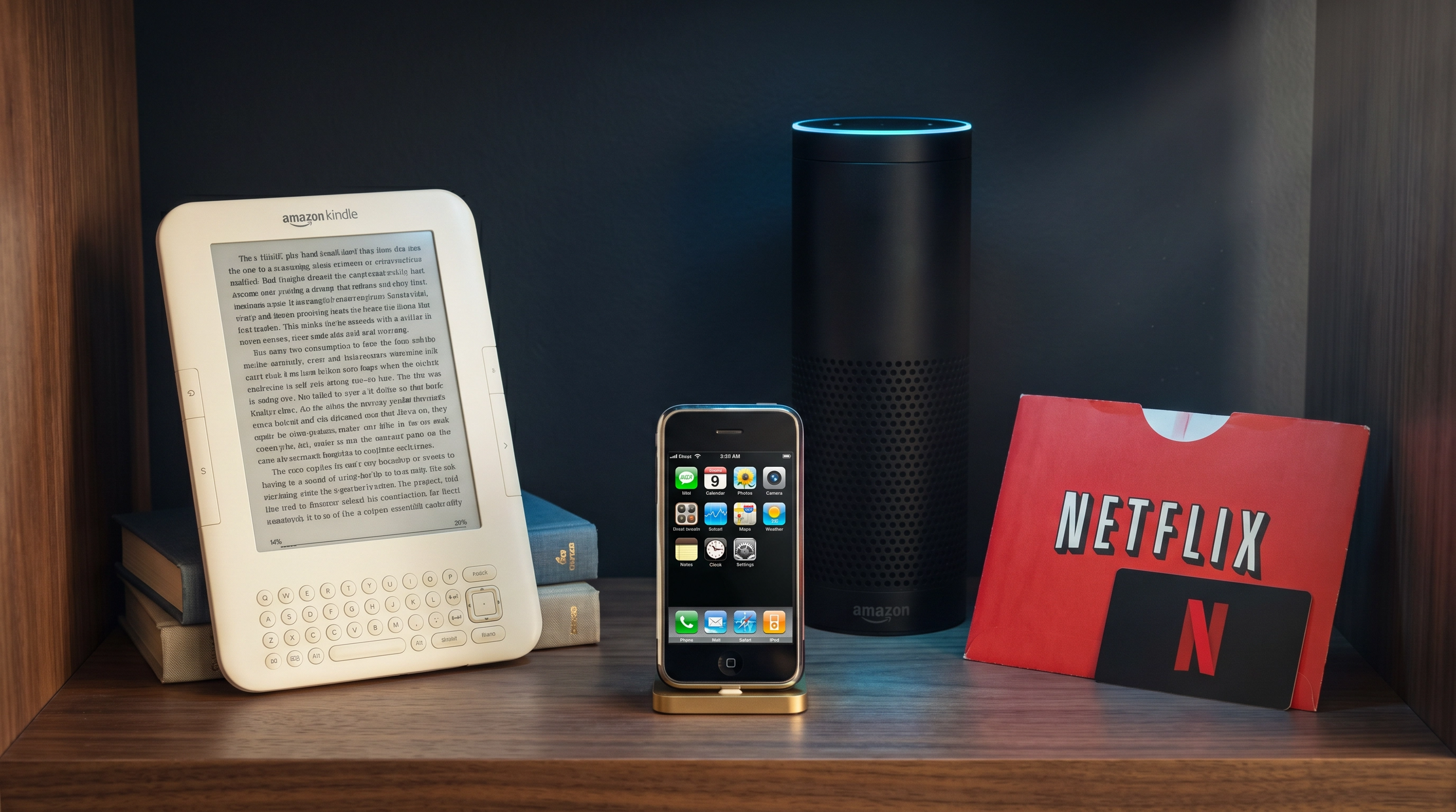
A rectangular slab of glass with a touch screen. You tapped little widgets to set alarms, check the weather, send messages, and play music. A small cylinder on your kitchen counter that listened to your requests, played songs, kept timers, and helped reorder household items. A thin gray rectangle that held a thousand books and let you download almost any title in under a minute from anywhere in the world. A streaming service that delivered a few hundred movies on a slow internet connection, and somehow felt like the future.
You know these products: the iPhone, Amazon Echo, Kindle, and Netflix. What is less obvious is that none of them arrived fully formed. They were incomplete ideas with enormous promise. Yet, for many of us, they are a very integral part of our everyday life.
Take the first iPhone in 2007. Steve Jobs introduced it as three things in one: a mobile phone, a widescreen iPod, and an internet communicator. It was a brilliant pitch because it made the future feel obvious. Of course these three things should collapse into one object. But the first iPhone was also deeply incomplete. No App Store, no copy and paste, no video recording, no front-facing camera, no 3G. And yet the core insight was complete- the phone could become the primary personal computer in your pocket. Everything else came later. Apps, cameras, payments, maps, the endless ecosystem of daily behaviors that now live inside that slab of glass.
The Kindle followed a similar arc. The first version was awkward, the design strange, the screen gray. It did not replicate marginalia, browsing, lending, or the physical pleasure of a library. But it nailed the core promise: any book, anywhere, almost instantly. It did not need to be better than books at everything. It only needed to be dramatically better at one thing.
Amazon Echo was often more novelty than necessity. It could play music, answer simple questions, and set timers. It got things wrong. It was limited. But the idea underneath was powerful: computing could move from screens to ambient space. You did not have to open an app. You could just ask.
As someone who was a contributor and had an incredible insiders view of both the Kindle and Echo product cycles, I can tell you. The conviction was real, the focus was relentless and the imperfections were just lessons along the way.
Netflix streaming launched in 2007 with roughly a thousand titles, a thin catalog by any measure. The interface was clunky, the selection felt like the back shelf of a video store, and picture quality depended entirely on your connection. But the insight was sharp: remove the trip to the store, the late fees, the physical disc, the burden of watching something in a hurry and something fundamental changes about how people watch. In hindsight, the library did not matter as much as the behavior it unlocked. Within a few years an entire industry has reorganized around the idea.
Iconic products rarely launch as polished, complete answers. They begin as sharp provocations, making a future behavior visible before the technology is fully ready to support it. If they get one important thing right, they earn the right to evolve. Version one is never the answer. It is the opening argument.
We are inside one of those moments right now.
A simple text box. You type a question, it types back. That was ChatGPT in late 2022. No memory, no reasoning, no agents, no ability to take action in the world. It hallucinated confidently. Easy to play with, easy to underestimate.
But the insight underneath was not a smarter search engine. It was something stranger and bigger: language itself could become an interface. You did not need to learn software or know how to code. You just had to know what you wanted. English catapulted to being the most valuable programming language.
We all know how the last two years have played out. AI is not a chatbot anymore. It is inside the tools you use to write, design, build, and ship. It reviewed this blog post and gave me good feedback. It helped generate the image that you see alongside this post. It is writing code alongside engineers, drafting strategies alongside executives, compressing weeks of research into an afternoon. The behavior it unlocks is still early and rapidly accelerating. Most people are only beginning to feel it.
The mistake, as always, is to judge the beginning by what it lacks. The better question is, what new behavior is it and will it make possible? Because we are not watching this one from a distance. We are living inside the incomplete idea, right now