

On AI, Search and Google
Until late last year, I was firmly in the “AI won’t kill search” camp. The whole conversation felt overblown, even as players like Perplexity and Bing made bold claims. Google Search worked for billions: fast, reliable, accurate, convenient, universally available, and deeply monetized. There wasn’t an obvious reason for users to switch. They hadn’t switched in decades, and it felt unlikely that AI would suddenly supplant it.
Then I sensed my own behavior change. I still use search, but increasingly as a fallback. When I need synthesis or a quick answer across sources, I go to a chatbot first. The shift is small but noticeable: from “find links and decide” to “ask and get an answer.” It’s not just a better interface; it changes how I approach the problem. This is where my original view broke. Search isn’t going away, but parts of it are. Navigational queries, quick facts, comparisons, summaries—all moving toward AI. Search still holds up for discovery and commercial intent, but it’s no longer the default starting point for everything.
Google seems to see this clearly. Search is still doing its job. Last quarter, it grew 19% to $60.4 billion, with queries at an all-time high and AI features driving more usage, not less. The “AI kills search” argument doesn’t hold up. The more interesting shift is happening next to it. Google Cloud hit $20 billion in revenue, up 63% year-over-year, with backlog crossing $460 billion. They’re supply-constrained, which is not a bad place to be. This isn’t a side business anymore—it’s where the growth is coming from.
We’ve seen this play out before. When Satya Nadella took over Microsoft, he didn’t try to reinvent Windows or Office. He let those profit machines keep running, but shifted the focus to Microsoft Azure. Today, Intelligent Cloud is one of Microsoft’s core drivers: $34.7 billion last quarter, growing 30%, with Azure at 40%. The AI business is already at a $37 billion run rate, while personal computing has faded into a smaller part of the mix—still profitable, just no longer central to growth.
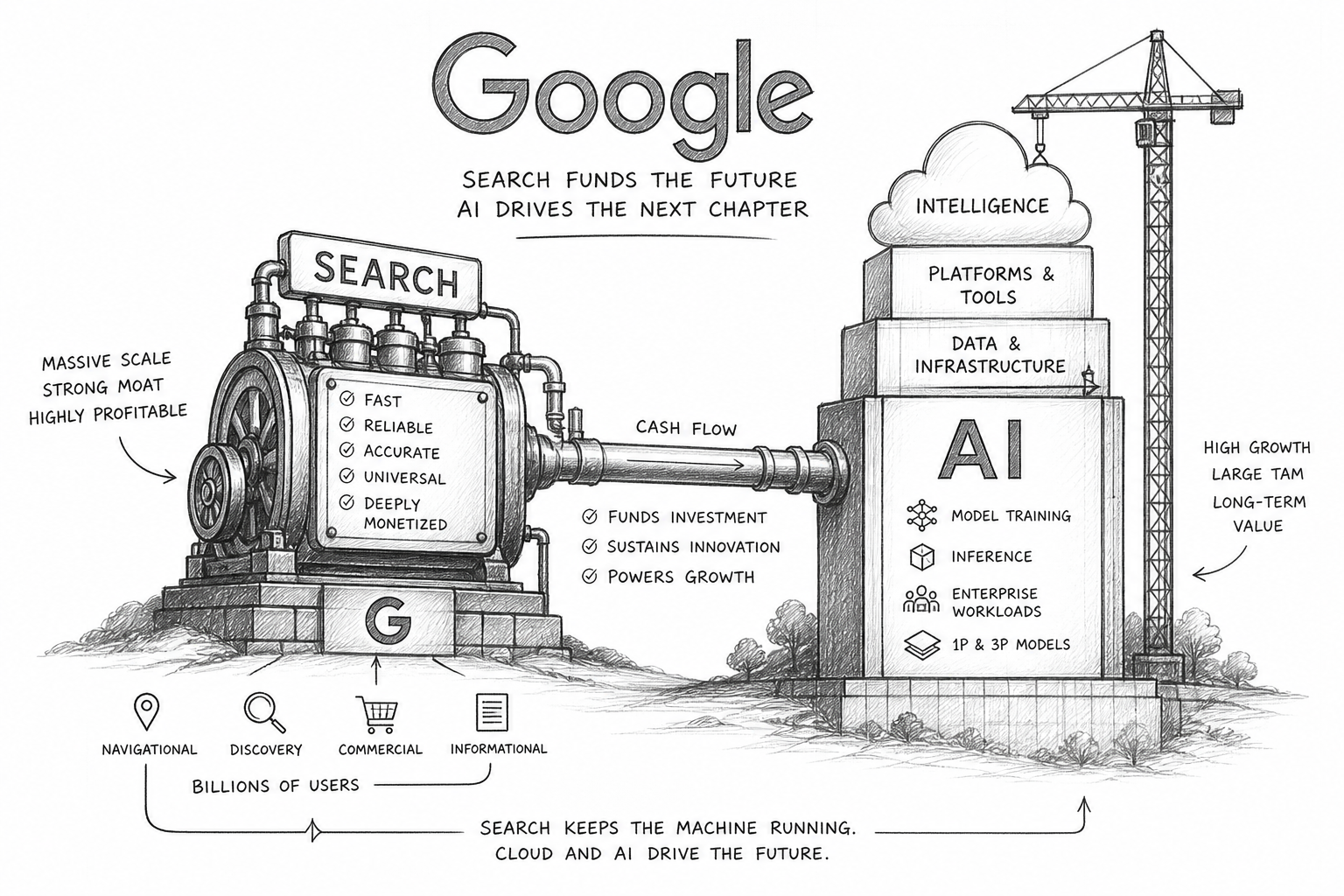
Google feels like it’s on a similar path. Search is its Windows and Office: steady, highly profitable, and not going anywhere. AI will reshape parts of it, but the bigger shift is happening underneath—training models, running inference, and serving enterprise workloads across first- and third-party models. This is where demand is building, and right now, demand is ahead of supply. There are tradeoffs. Cloud is expensive to build, margins are tighter, and competition from Amazon Web Services and Microsoft is real.
Google’s rising capex reflects that. But zooming out, the structure is clear: search keeps the machine running, while cloud and AI drive growth. The mistake is treating this as “AI vs. search.” It’s not a replacement story; it’s a shift in what powers the business. Google’s advantage won’t come from defending search—it will come from using it to fund what comes next.